RAG · Qdrant · Flask · LLMs
Xerebro — operational RAG
Production RAG assistant over the daily operational reports of Mexico's National Refining System. Answers in natural language citing its source, with automatic failover between LLMs.
290
days with indexed report
2,030
chunks in Qdrant
7
refineries
● via Xerebro's MCP server · latest report October 17, 2026 · refreshed daily
 see it live
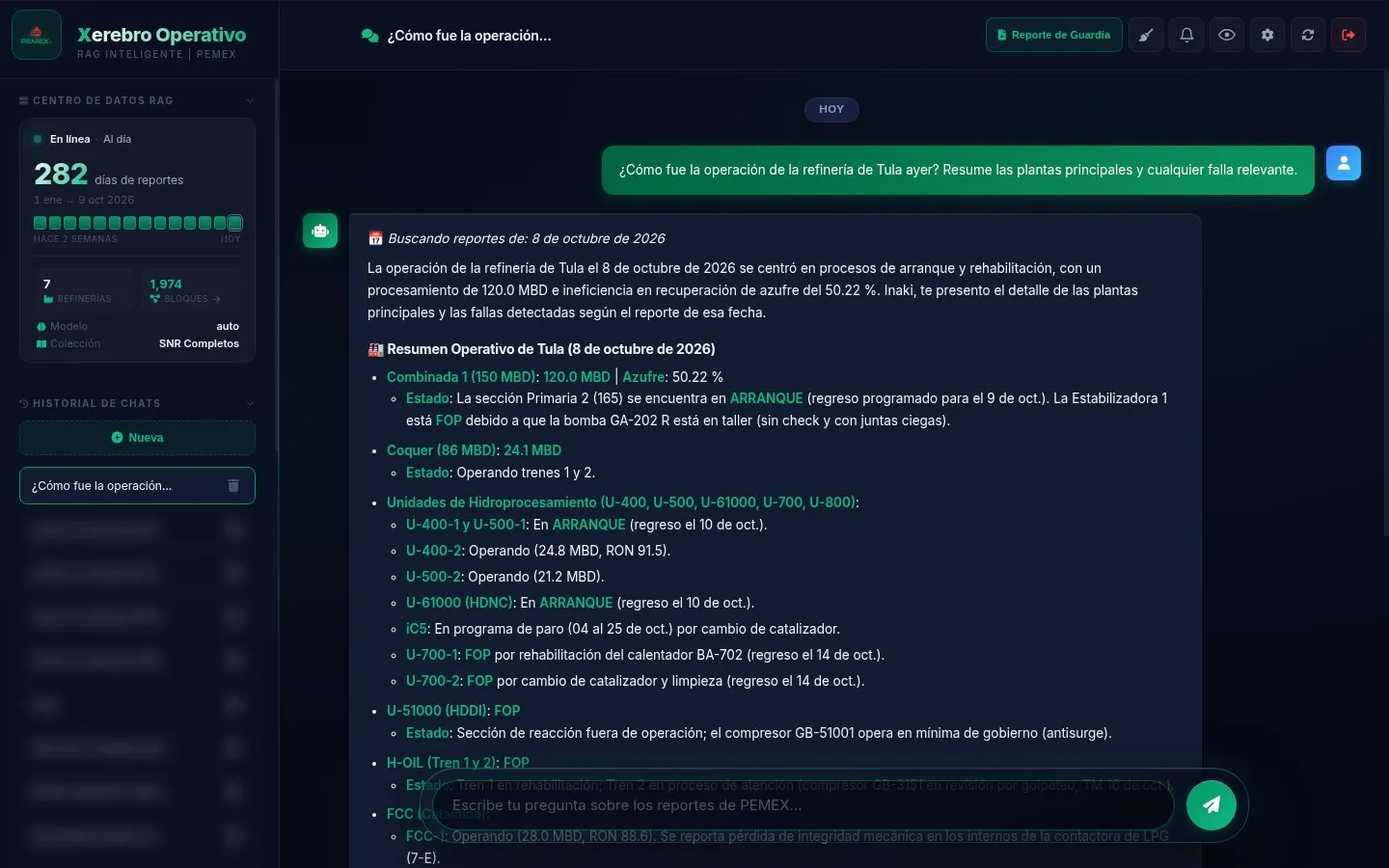
● live page · inaki-vpn.asuscomm.comXerebro in production. Access requires an account because it's an internal system; the screenshot shows a real query.
see it liveProblem
The refineries of Mexico’s National Refining System produce operational reports every day: throughput, equipment failures, shutdowns and start-ups. The information exists, but finding out “what happened to pump P-101 at Salina Cruz on August 15” means opening and reading reports one by one. And an AI answer with no source is useless in an operational setting: it has to be verifiable.
Solution
Xerebro is a RAG platform that answers technical and operational questions in natural language, citing the report, refinery, date and shift each fact comes from. I designed and built it, and run it in production: every day the report from all seven refineries is indexed, and the numbers above come straight from its MCP server.
Before searching, the system classifies the question’s intent to avoid wasted calls:
- Conceptual (“what is hydrodesulfurization?”): answered from a technical knowledge base (glossary, refinery profiles, business rules) without touching the vector store.
- Operational (“how many barrels did Tula process yesterday?”): semantic search in Qdrant with date, refinery and equipment pre-filters.
- Hybrid: combines both sources.
Architecture
- Retrieval: question embeddings and Qdrant search, with deterministic parsing of natural language dates (“yesterday”, “on Monday”, “August 15”) and equipment tag detection.
- Generation: an LLM cascade (Gemini, Groq, OpenRouter). When a provider returns a quota error (429), it goes into cooldown and the request moves to the next one without the user noticing.
- Application: Flask with SSE streaming, session auth, per-user history backed up to AWS S3 and real-time admin notices.
- Security: rate limiting on SQLite in WAL mode, temporary IP lockout on brute-force attempts and bot filtering.
- Operations: Docker, Gunicorn and Nginx with TLS on Linux.
Results
- In production, with a new report indexed every day (live numbers above).
- 85 automated tests that run offline.
- Fewer provider quota errors and fewer unnecessary vector-store queries thanks to intent routing.
Stack
Python, Flask, Qdrant, Gemini, Groq, OpenRouter, SQLite (WAL), AWS S3, Docker, Gunicorn, Nginx, Linux.
The code is private because it’s an internal system; happy to walk through it in an interview.